Sound-based, interactive web installation
Theblackmap
A digital lament · Birsen Roman
Enter the installation ↗Theblackmap grew from a personal lament I composed during a period when I was subjected to gender-based violence. The composition and arrangement carry the memory of my attempts to escape, the interference I encountered, and the moments when I felt I had surrendered to that violence.
In this installation, the lament moves beyond my own story to make visible the lives of other women cut short by violence. The stains accumulating on the surface are traces left by an existence that others sought to extinguish; approaching, touching and listening become forms of encounter. A personal voice opens into a shared visibility and a call to be heard.
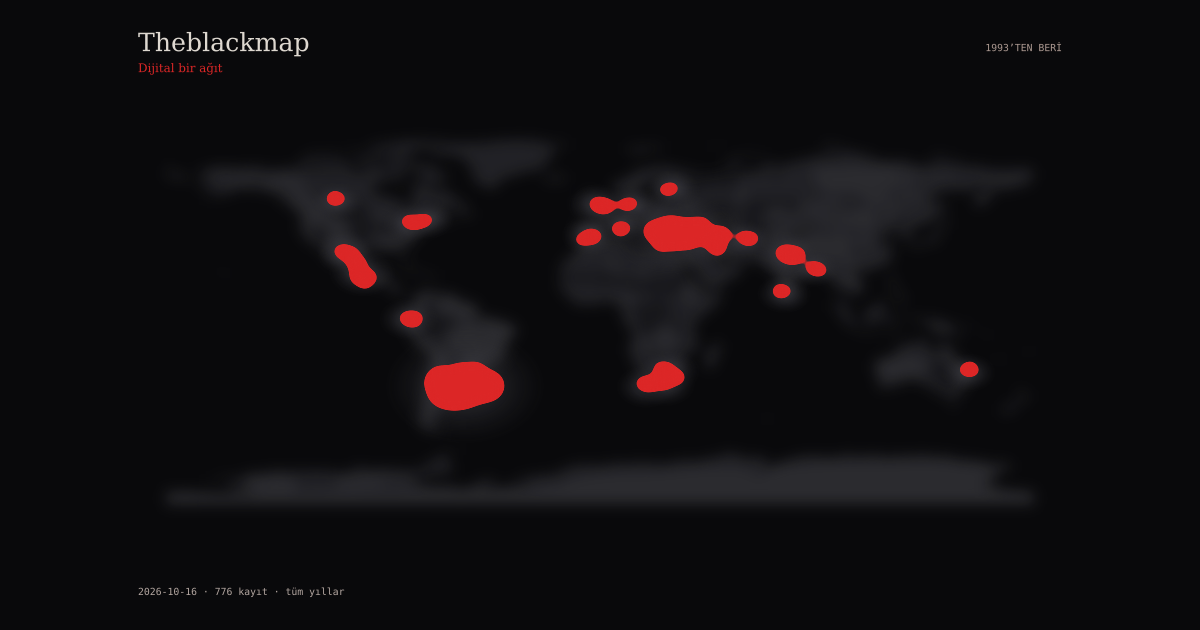
Starting point of the research
The work grew from a desire to investigate whether gender-based violence carries historical and social patterns beyond isolated, random events. It asks which power relations come into conflict with women’s efforts to become visible and sustain their existence. Records are brought together to explore these questions and create a space for remembering lives lost.
Medium and presentation
Created with web application tools, Theblackmap is a browser-based digital installation combining sound, a moving visual surface and visitor interaction. An automated process searches records dating from 1993 to the present and adds new traces to the surface as new data becomes available, allowing the installation to continue evolving over time.
Visual language and navigation
The candle-wax crack motif is the visual symbol of the lament. The records’ geographic references become clusters of stains on a dark surface without boundary lines. Records from different years coexist on the same surface. Approaching with a pointer or touching opens name cards; each card leads to record details and source links.
Sound and interaction
The red dot on the close button expands and contracts in a silent heartbeat. Opening a card brings a name and its traces before the visitor; the button that ends this visibility simultaneously carries a sign of presence. Opening begins the encounter; closing makes it invisible again. The close button thus places the paradox of presence and absence within the visitor’s own action. Brief keystrokes accompany movement between stains and the opening of details or sources; the heartbeat remains visual.
Data, time and archive
The work draws on records documented by accessible sources from 1993 onwards; it is not an exhaustive worldwide count. A date-selectable archive stores a standardized daily image of the stain distribution alongside a copy of that day’s data. This part of the work is intended both to make visitors aware that data accessible today may be deleted or become inaccessible tomorrow, and to enable them to follow changes in the work’s stain distribution as new records are added.
Installation, composition and sound design: Birsen Roman